NANOMOTION HR4-K-S-3 Photoelectric Ceramic Motor
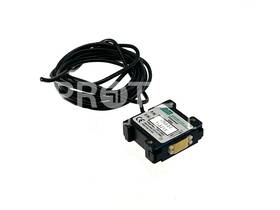
( Brand: Nanomotion ), ( Manufacturer Part Number: HR4-K-S-3 ), ( Part Type: Motor )
Review NANOMOTION Photoelectric Ceramic Motor Warranty
The **NanoMotion HR4-K-S-3** is a cutting-edge, ultra-precise **photoelectric ceramic motor** engineered to redefine motion control in applications where sub-micron accuracy, exceptional reliability, and compact form factor are paramount. This high-performance motor combines the unparalleled durability of **ceramic materials** with advanced **photoelectric feedback technology**, delivering seamless, closed-loop positioning with unmatched repeatability and minimal backlash. Ideal for demanding industries such as semiconductor manufacturing, medical robotics, optical instrumentation, and high-precision automation, the HR4-K-S-3 integrates a **high-resolution photoelectric encoder** directly into its ceramic rotor, eliminating mechanical play and ensuring flawless synchronization between motion commands and actual displacement. Its **hybrid ceramic-steel construction** not only enhances rigidity and thermal stability but also reduces wear over extended operational lifespans, making it a robust solution for environments where traditional motors would succumb to fatigue or misalignment. The motor s **compact, modular design** allows for seamless integration into tight spaces, while its **low inertia and high torque density** enable rapid acceleration and deceleration without compromising positional accuracy. Whether deployed in **wafer handling systems, micro-dispensing robots, or precision metrology tools**, the HR4-K-S-3 ensures that every movement is executed with surgical precision, minimizing errors and maximizing throughput. Backed by NanoMotion s proprietary **ceramic bearing technology**, this motor operates with virtually no friction, reducing energy consumption while extending maintenance intervals to unprecedented levels. With its **high-speed capability, bidirectional control, and compatibility with industry-standard interfaces**, the HR4-K-S-3 stands as a testament to the future of motion control where performance, longevity, and miniaturization converge to push the boundaries of what s possible in automation.
### **Pros and Cons of buying a Nanomotion HR4-K-S-3 Photoelectric Ceramic Motor**
#### **Pros**
1. **High Precision and Efficiency** The HR4-K-S-3 is a ceramic motor designed for ultra-precision applications, offering minimal backlash and smooth motion control. Its photoelectric feedback system enhances accuracy, making it ideal for scientific, medical, and industrial equipment where precision is critical.
2. **Compact and Lightweight Design** Ceramic motors are generally smaller and lighter than traditional motors with similar torque capabilities. This makes them suitable for space-constrained applications without sacrificing performance.
3. **Low Friction and Wear** Ceramic materials reduce friction and mechanical wear, leading to longer operational life and lower maintenance requirements compared to conventional motors.
4. **High Torque-to-Size Ratio** Despite its compact form, the HR4-K-S-3 delivers strong torque, making it efficient for applications requiring high force in limited spaces, such as robotics, lab automation, or precision positioning systems.
5. **Photoelectric Feedback for Closed-Loop Control** The integrated photoelectric encoder provides real-time position feedback, enabling precise closed-loop control. This is beneficial for applications requiring high repeatability, such as in CNC machines or optical instruments.
6. **Durability and Reliability** Ceramic motors are resistant to corrosion, temperature fluctuations, and environmental factors, making them suitable for harsh or cleanroom environments.
7. **Quiet Operation** Due to the absence of brushes and minimal mechanical vibration, these motors operate quietly, which is advantageous in sensitive applications like medical devices or laboratory equipment.
8. **Compatibility with Advanced Control Systems** The motor s feedback capabilities allow seamless integration with modern motion control systems, enabling advanced algorithms for trajectory planning and adaptive control.
---
#### **Cons**
1. **High Initial Cost** Ceramic motors, especially those with photoelectric feedback, are significantly more expensive than standard DC or stepper motors. The advanced materials and precision engineering contribute to a higher upfront investment.
2. **Limited Availability and Supply Chain Dependencies** Nanomotion is a specialized manufacturer, and their motors may not be as widely stocked as mainstream motor brands. Procurement delays or limited distributors could pose challenges.
3. **Sensitivity to Installation and Alignment** Due to their precision, these motors require careful mounting and alignment to avoid performance degradation. Improper installation can lead to reduced lifespan or inaccurate operation.
4. **Potential for Higher Power Consumption** While efficient, some ceramic motors may draw more current during acceleration or high-load operations compared to optimized stepper or servo motors, depending on the application.
5. **Limited Customization Options** Nanomotion s standard models may not offer extensive customization for unique torque, speed, or size requirements. Custom modifications could incur additional costs or lead times.
6. **Learning Curve for Integration** The advanced feedback and control features may require additional expertise to configure and optimize, particularly for users unfamiliar with closed-loop motion systems.
7. **Potential for Higher Maintenance Costs in Some Cases** While ceramic motors reduce wear, the precision components (e.g., encoders) may require periodic calibration or replacement, which could add to long-term costs if not properly maintained.
8. **Not Ideal for High-Speed Continuous Operation** While capable of high acceleration, ceramic motors may not be as efficient as traditional high-speed motors (e.g., brushless DC) for continuous high-speed applications without additional cooling or modifications.
---
### **Conclusion**
The **Nanomotion HR4-K-S-3** is a high-performance ceramic motor well-suited for applications demanding **ultra-precision, compact design, and reliability** in controlled environments. Its photoelectric feedback and low-friction properties make it a strong choice for **scientific instrumentation, medical devices, robotics, and industrial automation** where accuracy and durability are paramount.
However, the **high cost, limited availability, and specialized integration requirements** may make it less practical for budget-conscious or high-volume applications where standard motors would suffice. It is best reserved for **niche, high-value applications** where its advantages outweigh the drawbacks.
### **Recommendation**
- **Buy the HR4-K-S-3 if:**- You require **sub-micron precision** in positioning or motion control.
- Your application operates in a **cleanroom, sterile, or harsh environment** where corrosion resistance is critical.
- You need a **compact, high-torque solution** for robotics, lab automation, or medical devices.
- Closed-loop feedback and **repeatable accuracy** are non-negotiable.
- **Consider alternatives if:**- Your budget is constrained, and a **standard servo or stepper motor** with open-loop control would suffice.
- You require **high-speed continuous operation** (e.g., CNC machining), where traditional motors may be more efficient.
- You need **mass production or easy replacement parts**, as ceramic motors have limited aftermarket support.
For most **general industrial or consumer applications**, a conventional servo motor with encoder feedback may offer a better balance of cost and performance. However, for **cutting-edge, precision-driven projects**, the HR4-K-S-3 is a **superior choice** despite its higher cost. Always evaluate your specific requirements and consult with Nanomotion s technical support to ensure compatibility with your system.
Details:
Please review all photos and details before purchasing. P24 Nanomotion HR4-K-S-3 Photoelectric Ceramic Motor. 30-Day Return Warranty, Shipping and Handling. Have a question.
Reach out anytime.
part #: hr4ks3 prices
- $89.00-$99.00
specifications oelemot:
- brand: Nanomotion
- mpn: Hr4-k-s-3
- part type: Motor
offer oelemot:
- started: March 20, 2026
- quantity: 1
- availability: In Stock
- options: Ship-to-home
- sold: 0
returns oelemot:
- paid by: Seller
- time: 30 Days
- method: Money back
- policy: Returns Accepted
seller oelemot:
- # reviews: 3368
- rating: 99.8%
- city: Rocklin, California
shipping oelemot:
- transit: 5-11 Days
- class: Standard
- cost: $0.00
- service: Standard
- type: Fixed
general oelemot:
- condition: Used
- Industrial Automation Motion Controls > Electric Motors > General Purpose Motors
payments oelemot:
- credit card: Visa
- other
- wallet: Google-pay
Nanomotion HR4-K-S-3 Is Similar To:
- Nanomotion Fb050-020-.1m2 Fb050-050-.1m4 Piezoelectric Ceramic Linear Positioner Actuator 50mm (50% similar) Appears in very good condition believed used for testing only...(December 17th, 2024)
- Nanomotion Hr4-1-s-3 High Precision Ceramic Motor (68.5% similar) Shipped with USPS ground advantage. Nanomotion HR4-1-S-3 high precision ceramic motor. Condition is used...(August 18th, 2025)