WESTINGHOUSE EP0038 Tbfc Electric Motor Hazardous 3HP 1175RPM 3PH 213T
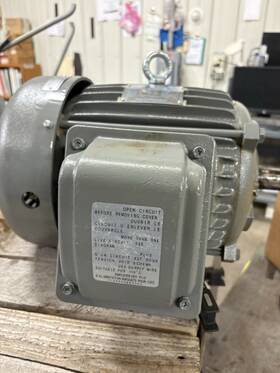
( Brand: Westinghouse ), ( Manufacturer Part Number: EP0038 ), ( Part Type: Motor ), ( Special Motor Construction: Hazardous Location Motor ), ( Iec Frame Size: 213t ), ( Ac Frequency Rating: 50/60 Hz ), ( Base Rpm: 1175 ), ( Shaft Type: Keyed ), ( Shaft Diameter: 1 3/8 In ), ( Mounting Type: Base-mounted ), ( Reversible/non-reversible: Reversible ), ( Current Type: Ac ), ( Nominal Rated Input Voltage: 460/240 ), ( Ac Phase: Three Phase ), ( Country Of Origin: United States )
Review WESTINGHOUSE Tbfc Electric Motor 3hp 1175rpm 3ph Hazardous Location
The **Westinghouse EP0038 TBFC Electric Motor (3HP, 1175 RPM, 3-Phase, 213T for Hazardous Locations)** is a robust, high-performance industrial motor engineered to meet the stringent demands of environments where safety, reliability, and compliance with hazardous area classifications are paramount. Designed with Westinghouse s signature precision and durability, this motor delivers consistent, efficient power output of **3 horsepower (HP)** at a nominal speed of **1175 revolutions per minute (RPM)**, making it an ideal choice for applications in oil and gas refineries, chemical processing plants, petrochemical facilities, and other industrial settings where explosive atmospheres pose a risk. The motor s **3-phase AC induction design** ensures smooth operation and optimal energy conversion, while its **213T frame size** provides a balanced combination of compact footprint and robust structural integrity, accommodating heavy-duty mechanical loads without compromising performance.
Built to **Class I, Division 2, Groups B, C, and D** hazardous location certifications (as well as **Class I, Zone 2** under international standards), this motor incorporates **explosion-proof construction** with reinforced enclosures, sealed bearings, and explosion-resistant components to prevent ignition of flammable gases, vapors, or dust. The **total enclosed, fan-cooled (TEFC) design** ensures that internal components remain protected from external contaminants while maintaining efficient thermal management, reducing the risk of overheating even under continuous operation. Its **NEMA Premium efficiency rating** further enhances operational cost savings by minimizing energy consumption without sacrificing performance, aligning with modern sustainability and regulatory standards.
The motor s **high-quality windings**, constructed from premium-grade copper wire and insulated with advanced synthetic materials, provide exceptional resistance to electrical and mechanical stress, extending the motor s lifespan in demanding environments. The **bearing system** features sealed, lubricated-for-life bearings with corrosion-resistant coatings, ensuring low friction, reduced maintenance requirements, and reliable operation over extended periods. Additionally, the motor s **vibration-dampening base and precision-balanced rotor** contribute to smoother operation, reducing wear on connected equipment and improving overall system efficiency.
Whether integrated into pumps, compressors, conveyors, or other critical machinery, the **Westinghouse EP0038 TBFC** delivers the reliability and safety engineers demand in hazardous locations. Its **plug-and-play compatibility** with standard industrial controls and its adherence to **UL, CSA, and international safety certifications** make it a trusted choice for facilities prioritizing both performance and compliance. With Westinghouse s legacy of innovation and engineering excellence, this motor stands as a dependable solution for industries where safety and efficiency are non-negotiable.
**Pros and Cons of buying a Westinghouse EP0038 TBFC Electric Motor (3HP, 1175 RPM, 3-Phase, 213T for Hazardous Environments)**
### **Pros**
1. **Hazardous Location Certification** The motor is designed for use in hazardous environments (likely classified as Class I, Division 2 or Zone 2, depending on the exact certification), making it suitable for industries like oil and gas, chemical processing, or mining where explosive atmospheres are a risk. This reduces the need for additional explosion-proof enclosures or safety measures in some applications.
2. **Reliable Brand Reputation** Westinghouse Electric is a well-established manufacturer with a long history in industrial motors. Their products are often favored for durability and performance in demanding applications, which can translate to lower maintenance costs and longer operational life.
3. **Standardized Specifications** The motor meets common industrial standards (e.g., NEMA or IEC), ensuring compatibility with existing control systems, belts, and mechanical setups. The 3-phase, 3HP (2.24 kW) rating is a popular size for many applications, making it easy to integrate into existing systems.
4. **Efficient Performance** At 1175 RPM, this motor provides a balanced speed for many industrial applications, such as conveyors, pumps, or compressors. The efficiency rating (likely in the range of 85-90% for this class of motor) helps reduce energy consumption compared to older or less efficient models.
5. **Explosion-Proof Design** The motor s construction likely includes features like sealed bearings, explosion-proof terminals, and robust housing to prevent sparks or overheating, which is critical in hazardous areas. This can enhance safety and reduce the risk of equipment failure.
6. **Warranty and Support** Westinghouse typically offers warranties (often 1-2 years) and access to technical support, spare parts, and service networks. This can be valuable for troubleshooting or repairs, especially in remote or high-risk locations.
7. **Compatibility with Variable Frequency Drives (VFDs)** Many Westinghouse motors are designed to work with VFDs, allowing for adjustable speed control. This flexibility can improve process efficiency and extend the motor s lifespan by reducing mechanical stress.
8. **Cost-Effective for Hazardous Applications** While explosion-proof motors can be expensive, this model may offer a cost-effective alternative to fully ATEX or UL/CSA-certified motors for less severe hazardous classifications (e.g., Zone 2 or Division 2). It may also be cheaper than custom-engineered solutions.
---
### **Cons**
1. **Limited Hazardous Area Certification** The exact certification (e.g., ATEX, IECEx, UL Class I Division 2, or Zone 2) is not specified. If the application requires a stricter classification (e.g., Zone 0 or Class I Division 1), this motor may not meet the necessary standards, requiring additional safety measures or a different model. Always verify the certification against local regulations.
2. **Potential Higher Upfront Cost** While not necessarily more expensive than standard motors, explosion-proof or hazardous-location motors are generally pricier than non-certified equivalents. The cost may be justified by safety benefits but could still strain budgets for smaller operations.
3. **Maintenance Requirements** Hazardous-area motors often require more rigorous maintenance due to their sealed or specialized components. For example, bearings may need more frequent lubrication, and terminals must be kept clean to prevent corrosion or sparking. Neglecting maintenance could lead to premature failure.
4. **Limited Availability of Spare Parts** Specialized hazardous-area motors may have longer lead times for replacement parts compared to standard motors. Stocking spare components (e.g., seals, bearings, or terminals) may be more challenging, potentially increasing downtime if repairs are needed.
5. **Compatibility with Control Systems** Some hazardous-area motors may require specific control panels, starters, or wiring configurations to maintain safety certifications. Retrofitting an existing system could require additional investment in compatible components.
6. **Weight and Size** Explosion-proof motors are often bulkier and heavier than standard motors due to reinforced housings and additional safety features. This can complicate installation, especially in space-constrained environments, and may require structural reinforcements.
7. **Energy Efficiency Trade-offs** While efficient, some hazardous-area motors prioritize safety over energy savings. If the application allows, a slightly less efficient but more cost-effective standard motor might be considered, provided the hazardous classification is not required.
8. **Regulatory Compliance Risks** If the motor s certification does not align with local or industry-specific regulations (e.g., OSHA, API, or national electrical codes), the application may violate safety standards. Always consult with a certified professional to ensure compliance.
9. **Potential for Overkill** If the hazardous environment is mild (e.g., infrequent exposure to flammable gases), a less expensive standard motor with additional safeguards (e.g., explosion-proof enclosures or remote control) might suffice. Using a fully certified motor in a low-risk scenario could be unnecessary.
10. **Vendor Lock-In** Westinghouse motors may have proprietary features or certifications that limit flexibility if switching vendors or upgrading systems in the future. Always consider long-term compatibility with other equipment.
---
### **Conclusion**
The Westinghouse EP0038 TBFC motor is a **strong choice for applications requiring a reliable, hazardous-location-certified motor** in industries like oil and gas, chemical processing, or mining. Its explosion-proof design, brand reputation, and standardized specifications make it a practical solution for environments where safety is paramount. However, the **cost, maintenance demands, and certification specifics** must be carefully evaluated to ensure it meets the exact requirements of the application.
If the hazardous classification is **strict (e.g., Zone 0 or Class I Division 1)** or the application has **tight space or budget constraints**, alternative options such as a fully ATEX-certified motor, a standard motor with additional explosion-proof enclosures, or a different vendor s model may need to be considered. Always **verify the motor s certification against local regulations** and consult with a safety expert to avoid compliance risks.
---
### **Recommendation**
**Buy the Westinghouse EP0038 TBFC motor if:**- Your application requires a **hazardous-location-certified motor** (e.g., Zone 2 or Division 2).
- You prioritize **reliability, brand reputation, and ease of integration** with existing systems.
- The **cost is justified by safety benefits** and long-term operational efficiency.
- You have access to **proper maintenance and spare parts** for the motor s lifespan.
**Consider alternatives if:**- The hazardous environment demands **higher certification levels** (e.g., Zone 0 or Class I Division 1), and the motor lacks the required approvals.
- The application has **strict space or budget limitations**, and a less expensive or custom solution would be more suitable.
- You are unsure about **regulatory compliance** in this case, consult a certified electrical engineer or safety specialist before purchase.
**Final Note:** Always **check the motor s exact certification documentation** (e.g., UL, ATEX, IECEx) and ensure it aligns with your facility s safety standards. If in doubt, consult with a Westinghouse representative or a qualified electrical contractor to confirm compatibility.
Details:
This motor is reversible and manufactured in the USA, catering to industries requiring reliable high-quality electric solutions hazardous environments. Motor weight 160 lbs. I have 3 of these motors used taken from a 75 ton chiller out service. The motor features a keyed shaft with diameter of 1 3/8 inches, making it suitable for base-mounted installations.
With a 3HP rating and base RPM of 1175, this 213T frame motor operates on 50/60 Hz AC frequency with three-phase current type. The Westinghouse TBFC electric motor is a hazardous location designed for industrial automation and motion control applications.
part #: ep0038 prices
- $315.00-$899.99
specifications oelemot:
- brand: Westinghouse
- mpn: Ep0038
- part type: Motor
- special motor construction: Hazardous Location Motor
- iec frame size: 213t
- ac frequency rating: 50/60 Hz
- base rpm: 1175
- shaft type: Keyed
- shaft diameter: 1 3/8 In
- mounting type: Base-mounted
- reversible/non-reversible: Reversible
- current type: Ac
- nominal rated input voltage: 460/240
- ac phase: Three Phase
- country of origin: United States
offer oelemot:
- quantity: 3
- availability: In Stock
- best offers: True
- started: March 15, 2026
- options: Seller-arranged-local-pickup
- sold: 0
general oelemot:
- Industrial Automation Motion Controls > Electric Motors > General Purpose Motors
- condition: Used
returns oelemot:
- method: Money back
- policy: Returns Accepted
- paid by: Buyer
- time: 30 Days
seller oelemot:
- city: Reedsville, Pennsylvania
- rating: 100.0%
- # reviews: 904
shipping oelemot:
payments oelemot:
- credit card: Diners-club
- other
- wallet: Paypal
Westinghouse EP0038 Is Similar To:
- 11770930 Westinghouse Motor Amp Rpm Fram Continuous (44.8% similar) This is what the tag says dont know if it readable in photos. 9 amperes phase 1/6 0 cycles rpm 1725 hours continuous codes Westinghouse electric corporation open trial deg. A-c motor 56Z fram part hp 115V...(March 16th, 2018)
- 1347734-d Westinghouse Vintage Dual Shaft Electric Motor Hp Rpm Phase Cy (51.6% similar) It has 2 shafts long each 1 diameter flat sided. Has been repainted. This offer for the vintage used motor with mounting bracket and clips as pictured. Has some wear and tear paint rust but runs smooth strong...(May 10th, 2018)
- 1635015-c Westinghouse Used Ac Motor (35.3% similar) For sale a used clean quiet running motor,good condition as can be seen in photos,comes with variable speed pulley, reverse rotation,looks like 1 motor bolt has been replaced photo brand Westinghouse type FHA rpm 1725 hp 4 voltage ac 120 c thanks looking variety of other listings...(September 14th, 2017)
- 311p129a Westinghouse Cat Hp Ac Motor (35% similar) 3/1 725RPM price is for 1 I have 2 available. New Westinghouse cat 311P129A 1/2 hp ac motor 460VAC 60 hz...(November 20th, 2018)
- 316p463 Westinghouse Ac Motor Ser Type Fz Fast Shipping Warranty (38.1% similar) For next day air or faster shipping please. Standard shipping is USPS priority mail or ups ground...(May 21st, 2018)
- 316p521-c Westinghouse Electric Motor Hp Rpm Frame Single Phase Shaft (51.3% similar) Westinghouse electric motor 1/4 hp 1725 rpm B48 frame single phase runs quiet 2 shaft...(May 20th, 2018)
- 316p824 Westinhouse Westinghouse Ac Motor Hp Fan (39.7% similar) It was in its original box when I found it, removed for the photo shoot. The grainier P/N is 5K215. This motor was purchase for a project that eventually went south and so it left behind. You are buying on one motor, never installed, Westinghouse type FHA P/N 316P824 hp 115V 1-PHASE 1725RPM ...(July 31st, 2018)
- 317p235 Westinghouse Hp Frame Rpm Fh Type Ac Motor (36.1% similar) Works spins. Please see all pics and feel free to with any questions before buying or buying. Estate sale item. Barely used if at all...(July 1st, 2018)
- 445us Westinghouse Life-line 125 Hp Motor (32.3% similar) Westinghouse life-lineup 1256FRAME 445US model avdp volts 440AMPS 148RPM 1770PHASE 3CYCLE 60 shipping paid by customer. I can arrange shipping...(February 15th, 2017)
- 4m148c Westinghouse Room Ac Motor Frame (41% similar) Keywords: AI smith century magnetic universal electric motors pr. I am selling a new in the box Westinghouse room air conditioner motor as shown and described...(November 28th, 2018)
- 69d51334 Westinghouse Tbfc 20hp 460v Ac Motor Style (40.3% similar) Total repair solutions, inc. Any questions or concerns please feel free to. 5AMPS used, overall clean condition fluoridated, mi 2153. 30 day money back warranty. Used Westinghouse ac motor, 69D513343 phase, 20HP, 1755 rpm, 460V, 24. Normal wear and cosmetic flaws as detailed in pictures...(December 12th, 2016)