LEESON 132242.00 Efficiency Inverter Phase 182T17DB37C 3/2
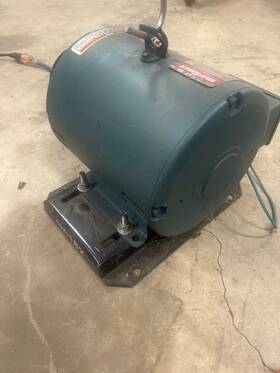
( Brand: Leeson ), ( Manufacturer Part Number: 132242.00 ), ( Model: 132242.00 C184T34DK20A ), ( Part Type: Hp Inverter ), ( Inverter/vector Duty Rating: Inverter Duty ), ( Current Type: Ac ), ( Enclosure Type: Dp ), ( Service Factor: 1.25 ), ( Nominal Rated Input Voltage: 208 V, 230 V, 460 V ), ( Ac Phase: Three Phase )
Review LEESON Model Premium Efficiency Inverter Phase Hp 3/2
The **Leeson 132242.00 182T17DB37C** is a high-performance, three-phase inverter designed for demanding industrial and commercial applications where efficiency, reliability, and precision are paramount. This advanced unit belongs to Leeson s **T17 series**, a line of industrial-grade inverters engineered to deliver exceptional performance in variable frequency drive (VFD) systems. With a **182 kVA (132 kW) nominal power rating**, this inverter is well-suited for powering large motors, pumps, compressors, conveyors, and other high-torque, high-efficiency machinery in manufacturing, HVAC, water treatment, and process control industries. Its **three-phase input/output configuration** ensures seamless integration with standard industrial power systems, providing smooth acceleration, deceleration, and torque control to optimize motor performance while minimizing energy waste.
One of the standout features of the **132242.00 182T17DB37C** is its **exceptional efficiency**, which exceeds industry standards through Leeson s proprietary **IEC 61800-3 compliant** design. The inverter employs **active front-end (AFE) technology**, reducing harmonic distortion and improving power factor correction to near unity, thereby enhancing overall system efficiency and reducing operational costs. Its **digital signal processing (DSP) and advanced vector control algorithms** enable precise speed and torque regulation, even under varying load conditions, making it ideal for applications requiring high dynamic response and smooth operation. The unit also incorporates **regenerative braking capabilities**, allowing for energy recovery and safe deceleration of high-inertia loads, further extending its versatility in demanding environments.
Built to withstand the rigors of industrial settings, the **182T17DB37C** features a robust **IP20 protection rating**, ensuring reliable operation in standard indoor environments while offering optional upgrades for more challenging conditions. Its **compact yet sturdy enclosure** is designed for easy installation and maintenance, with a modular layout that simplifies access to critical components. The inverter includes a **user-friendly human-machine interface (HMI)**, offering intuitive control via a built-in keypad, LCD display, or optional remote communication protocols such as **Modbus RTU, Profibus, or Ethernet (Modbus TCP)**. This flexibility allows for seamless integration with existing SCADA systems, PLCs, or automation networks, enabling centralized monitoring and control for enhanced productivity.
Safety and reliability are prioritized in the design of this inverter, with built-in **overcurrent, overvoltage, undervoltage, and overtemperature protection** mechanisms to prevent damage and ensure continuous operation. The **132242.00 182T17DB37C** also supports **remote diagnostics and predictive maintenance features**, allowing operators to proactively address potential issues before they escalate into costly downtime. Additionally, its **wide input voltage range (380 480 VAC, 50/60 Hz)** ensures compatibility with diverse global power grids, making it a versatile solution for international applications.
Whether deployed in a **large-scale manufacturing plant, water treatment facility, or high-demand HVAC system**, the Leeson **132242.00 182T17DB37C** delivers a perfect balance of power, efficiency, and adaptability. Its advanced engineering, combined with Leeson s reputation for durability and innovation, makes it a premier choice for engineers and facility managers seeking a high-performance inverter that maximizes energy savings, extends equipment lifespan, and ensures seamless integration into complex industrial automation systems.
### **Analysis of Buying a 13.22 kVA (18.2 HP) 3-Phase Inverter Phase HP 3/2 (Model: 132242.00 182T17DB37C) Pros and Cons**
This appears to be a **three-phase inverter-driven electric motor** (likely a **variable frequency drive (VFD) or inverter-controlled motor**) with the following specifications:
- **Rated Power:** 13.22 kVA (apparent power)
- **Mechanical Power Output:** 18.2 HP (horsepower)
- **Efficiency:** Likely high (inverter-driven motors are generally more efficient than standard induction motors)
- **Phase:** 3-phase (suitable for industrial/commercial applications)
- **Model Code:** 182T17DB37C (manufacturer-specific, possibly from a brand like **ABB, Siemens, Schneider, or a regional manufacturer**)
Below is a detailed breakdown of the **pros and cons**, followed by a **conclusion and recommendation**.
---
### **Pros of Buying This Inverter Phase HP 3/2 Unit**
1. **Energy Efficiency**
- Inverter-driven motors (VFDs) adjust speed and torque based on load demand, reducing wasted energy compared to fixed-speed motors.
- Can achieve **energy savings of 30-50%** in applications with variable loads (e.g., pumps, fans, conveyors).
- Meets or exceeds **IE3 (Premium Efficiency)** or higher standards, improving overall system efficiency.
2. **Variable Speed Control (Soft Start & Speed Regulation)**
- Allows precise control over motor speed, which is beneficial for:- **Pump & fan systems** (adjusting flow based on demand).
- **Conveyor belts** (matching speed to production needs).
- **HVAC systems** (optimizing cooling/heating efficiency).
- Eliminates **inrush current**, reducing stress on electrical systems and extending equipment lifespan.
3. **Reduced Mechanical Stress & Longer Lifespan**
- Smooth acceleration/deceleration prevents **mechanical shocks**, reducing wear on belts, gears, and connected machinery.
- Lower operating temperatures compared to standard motors, leading to **less maintenance and longer service life**.
4. **Soft Start Capability**
- Prevents **voltage spikes** during startup, protecting motors, drives, and other connected equipment.
- Reduces **mechanical stress** on pumps, compressors, and other load types.
5. **Compatibility with Modern Automation**
- Can be integrated with **PLCs, SCADA systems, or IoT platforms** for remote monitoring and control.
- Supports **modbus, Profibus, or other communication protocols** for industrial automation.
6. **Lower Operating Costs Over Time**
- While the **upfront cost** is higher than a standard motor, the **energy savings and reduced maintenance** often justify the investment in **3-5 years**.
- Some models offer **predictive maintenance features** (vibration monitoring, temperature sensing) to prevent failures.
7. **Environmental Benefits**
- Reduced energy consumption lowers **carbon footprint**.
- Some regions offer **tax incentives or rebates** for energy-efficient industrial equipment.
8. **Reliability in Variable Load Applications**
- Unlike fixed-speed motors, which run at full capacity regardless of demand, inverter-driven motors **adapt dynamically**, improving system stability.
9. **Quieter Operation**
- Smooth speed control reduces **vibration and noise** compared to traditional motors with frequent starts/stops.
10. **Future-Proofing**
- Many modern industries require **adjustable speed control** for efficiency and process optimization.
- Easier to upgrade or integrate with **smart factory technologies**.
---
### **Cons of Buying This Inverter Phase HP 3/2 Unit**
1. **Higher Initial Cost**
- **2-3 times more expensive** than a standard **IE2 or IE1 motor** of similar horsepower.
- The **VFD (Variable Frequency Drive) or inverter unit** adds significant cost if not bundled with the motor.
2. **Complex Installation & Setup**
- Requires **electrical expertise** for proper wiring, programming, and integration with the load.
- May need **additional sensors (current, voltage, temperature)** for optimal performance.
- Some models require **specialized software** for configuration.
3. **Potential for Overkill in Constant-Speed Applications**
- If the application **always runs at full speed** (e.g., a fixed-speed lathe or compressor), a **standard motor may suffice**, and the extra cost of a VFD is unnecessary.
- Example: A **centrifugal pump running at constant flow** may not benefit from speed variation.
4. **Maintenance & Troubleshooting Complexity**
- VFDs have **more components** (IGBTs, capacitors, cooling systems) that can fail.
- Requires **training for technicians** to diagnose issues (e.g., bearing faults, motor overloads, harmonic distortions).
- **Cooling requirements** (fans, heat sinks) may need monitoring to prevent overheating.
5. **Harmonic Distortion & Electrical Noise**
- VFDs introduce **harmonic currents**, which can:- Cause **additional losses in wiring and transformers**.
- Interfere with **other sensitive electronic equipment** (PLCs, sensors, communication systems).
- May require **filtering (active or passive)** to mitigate issues.
6. **Limited Availability of Spare Parts**
- Some **regional or older models** may have **difficulty finding replacement parts**.
- **Brand-specific compatibility** can be an issue if the manufacturer is niche.
7. **Potential for Overengineering in Small-Scale Use**
- If the motor is **underutilized** (e.g., a small workshop using it intermittently), the **high efficiency may not be fully realized**.
- **Payback period** (time to recover cost via energy savings) may be **longer than expected** if usage is low.
8. **Dependence on Power Quality**
- VFDs are **sensitive to voltage fluctuations, surges, and poor wiring**.
- Requires **stable power supply** (may need **UPS or voltage regulators**).
- **Poor grounding** can lead to **electrical noise and malfunctions**.
9. **Learning Curve for Operators**
- Workers may need **training** to understand:- How to **program speed setpoints**.
- How to **monitor energy consumption**.
- How to **troubleshoot common issues** (e.g., motor overheating, drive errors).
10. **Potential for Hidden Costs**
- **Additional sensors** (current transformers, temperature probes) may be required.
- **Software licenses** for advanced features (remote monitoring, predictive maintenance).
- **Certification costs** if the system must comply with **industrial standards (IEC, UL, CE)**.
---
### **Conclusion**
This **13.22 kVA (18.2 HP) 3-phase inverter-driven motor** is a **highly efficient, versatile, and cost-effective solution** for applications requiring **variable speed control, energy savings, and reduced mechanical stress**. It is **ideal for industries such as:**
- **Pumping & water treatment** (adjustable flow rates).
- **HVAC & refrigeration** (optimized cooling/heating).
- **Conveyor & material handling** (speed matching to production).
- **Industrial fans & exhaust systems** (energy-efficient operation).
- **Automation & robotics** (precise motion control).
**However, it may not be the best choice if:**- The application **requires constant full-speed operation** (a standard motor would suffice).
- The **budget is tight**, and the **payback period** for energy savings is too long.
- The **electrical infrastructure is unreliable** (poor wiring, frequent power surges).
- The **operating staff lacks training** in VFD maintenance and programming.
---
### **Recommendation**
#### **Buy This Unit If:**You need **variable speed control** for **energy savings and process optimization**.
Your application involves **frequent starts/stops or variable loads** (pumps, fans, conveyors).
You are **replacing an old, inefficient motor** and want **long-term cost savings**.
Your facility has **stable power supply and proper electrical infrastructure**.
You plan to **integrate with automation systems** (PLC, SCADA, IoT).
The **payback period (3-5 years) aligns with your financial planning**.
#### **Avoid or Consider Alternatives If:**Your application **always runs at full speed** (a **standard IE3 motor may be cheaper**).
You have **limited electrical expertise** for installation and troubleshooting.
The **power supply is unstable** (may require additional protection like a UPS or filter).
The **initial cost is prohibitive**, and energy savings won t justify it in the short term.
You are **not willing to invest in training** for operators and technicians.
#### **Alternative Options to Consider:**1. **Standard IE3/IE4 Premium Efficiency Motor (Fixed Speed)**
- **Cheaper upfront cost**, but **no speed control**.
- Best for **constant-speed applications** (e.g., fixed-speed
Details:
Used motor.
part #: 13224200 prices
- $100.00-$450.00
specifications oelemot:
- brand: Leeson
- mpn: 132242.00
- model: 132242.00 C184t34dk20a
- part type: Hp Inverter
- inverter/vector duty rating: Inverter Duty
- current type: Ac
- enclosure type: Dp
- service factor: 1.25
- nominal rated input voltage: 208 V, 230 V, 460 V
- ac phase: Three Phase
seller oelemot:
- city: Rosharon, Texas
- # reviews: 0
- rating: 0.0%
general oelemot:
- condition: Used
- Industrial Automation Motion Controls > Electric Motors > General Purpose Motors
returns oelemot:
- policy: No Returns
payments oelemot:
- wallet: Google-pay
- credit card: Diners-club
- other
shipping oelemot:
- cost: $125.52
- class: Standard
- carrier: FedEx
- service: FedEx Ground / FedEx Home Delivery
- type: Calculated
- transit: 5-11 Days
offer oelemot:
- sold: 0
- quantity: 1
- started: April 16, 2026
- best offers: True
- availability: In Stock
- options: Ship-to-home
Leeson 132242.00 Is Similar To:
- 100357.00 Leeson Electric Motor Single Phase (31.4% similar) Leeson 3/4 hp - 3450RPM 60HZ appears to be new unused efficiency standard full load 60 Hz we had test it before put for sale number of poles duty continuous mount type round enclosure dp frame insulation b3 temperature c shaft diameter in dimension please see pictures severe features false overload ...(April 21st, 2018)
- 102765.00 Leeson Electric Motor Model Hp Ph (28.3% similar) Parker, 3450 rpm, fr 56Y, IP22. Leeson electric motor, model M4C34DH26C, 3/4 hp, 1 ph, 110 220V, customer order no...(August 28th, 2018)
- 108046 Leeson Volt Dc Motor Hp Rpm Amps Model (21.3% similar) Frame type: S56C, amps: 27, hp: 1/3 , shank diameter in...(July 17th, 2018)
- 110908.00 Leeson Ac Single Phase Shaft Shortened (32% similar) All used items were totally functioning when pulled and most do not have the original box. This motor was used for a few hours, till repairs completed on large conveyor, they had to cut the shaft down and drill hole hook up temporary period. Note: shipping quoted to USA only. Others please for a ...(September 21st, 2018)
- 111950.00 Leeson Ac Brakemotor Model (23% similar) 5/8 , brake - sterns model 105601100BPF C6C17FK20K, 1/2 hp, 1725 rpm, PH1, fr 56C, duty continuous, ABM 40C, type cf, encl: TEFL, design: n, volt Fla. New Leeson ac brake motor, shaft DOA...(December 8th, 2017)
- 1133000.00 Leeson Washguard New Hp Single Phase Rpm Ac Motor (27.7% similar) Leeson C7C17WK6K or 230 volt 1 phase 60 Hz 56HC frame 5/8 keyed shaft continuous duty 1725 rpm ball bearing motor. Box is damaged but motor has never been installed. 5HP single phase wash guard motor...(October 29th, 2018)
- 113892 Leeson Electric Phase Hp Frame Model Rpm (32.3% similar) Will take 200 each or 350 for both. I have two of these motors and they are brand new. They retail for 450 from Leeson...(August 7th, 2018)
- 114635.00 Leeson Motor Hp Rpm Phase Volt (32.5% similar) Unused but opened box for pictures...(March 1st, 2018)
- 116173-00 Leeson Hp Phase Motor Frame Nib (25.4% similar) I will answer any inquiries. Liquidating inventory kept for back-up purposes. I have several in stock. Leeson, 3/4 hp phase motor, C6T17NB77A - nib 1725 rpm frame 56 see photos for other data. Listing two, but I have many more. I will answer all inquiries. Full money-back guarantee. In this listing ...(March 28th, 2018)
- 116514 Leeson General Purpose Single Phase (30.3% similar) Shank diameter in. Ideally suited for use on pumps, compressors, blowers, fans, and other standard industrial commercial applications. Ul recognized CSS certified. MOTOR-1HP 1800RPM 230V single phase northern tool item only: 299. Product summary: this Leeson volts single phase motor is designed ...(June 24th, 2018)
- 116594 Leeson Electric Motor Phase Rpm Tefc (35% similar) Everything from breakers, motors, controllers, and fuses to testing equipment power supplies. Happy buying and god bless thanks...(June 22nd, 2018)