ELECTRIC 115801525 Belt Drive Motor Arwje Dayton 1/3
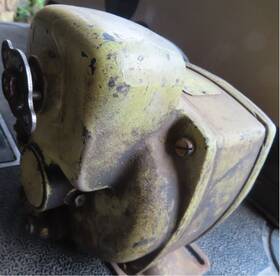
( Brand: Electric ), ( Manufacturer Part Number: 115801525 ), ( Model: DAYTON ), ( Part Type: Hp Belt Drive Motor ), ( Rated Load: Hp ), ( Current Type: Ac ), ( Nominal Rated Input Voltage: 115 V ), ( Ac Phase: Single Phase ), ( Base Rpm: 1725 )
Review ELECTRIC Used Belt Drive Motor 1/3 Hp 11580 Arwje No Returns
The **115801525 Belt Drive Electric Motor (1/3 HP, Model 11580 ARWJE)** is a robust, high-performance industrial motor designed for applications requiring reliable, efficient, and durable power transmission. Engineered with precision, this motor delivers a consistent output of **1/3 horsepower (0.25 kW)** at a nominal voltage of **115 volts AC**, making it ideal for a wide range of mechanical systems, including conveyors, pumps, compressors, and small industrial machinery. Its **belt-driven design** ensures smooth and efficient power transfer, reducing wear on connected components while minimizing noise and vibration, which is critical for maintaining operational longevity and system stability.
Constructed with **high-grade materials**, this motor features a **cast iron end bells and housing**, providing exceptional strength and resistance to thermal expansion, corrosion, and mechanical stress. The **ball-bearing support system** ensures low-friction operation, extending the motor s lifespan while maintaining optimal efficiency. The **11580 series** is renowned for its compact yet sturdy build, allowing for easy integration into tight spaces without compromising performance. Its **standard NEMA 56C frame** ensures compatibility with a broad range of industrial gearboxes, pulleys, and mechanical couplings, making it a versatile choice for various applications.
Operating at a **synchronous speed of 1725 RPM** (at 60 Hz), this motor is optimized for applications where moderate speed and torque are required. The **single-phase induction design** ensures reliable starting performance, while its **overload protection** mechanisms help prevent damage from sudden electrical surges or mechanical overloads. The motor s **low-maintenance construction** eliminates the need for frequent lubrication, as the sealed bearings are designed to operate efficiently with minimal upkeep, reducing downtime and operational costs.
Ideal for **light to medium-duty industrial, commercial, and HVAC systems**, this motor excels in environments where reliability and efficiency are paramount. Whether used in **air handling units, small-scale manufacturing equipment, or material handling systems**, the **115801525 belt drive motor** delivers consistent performance under varying loads. Its **universal compatibility** with standard industrial controls and its **energy-efficient operation** make it a cost-effective solution for businesses seeking durable, long-lasting power transmission without excessive energy consumption.
For applications where precision and dependability are critical, this motor stands out as a **proven workhorse**, offering a perfect balance of power, durability, and ease of installation. Its **standardized design** ensures quick replacement compatibility with existing systems, while its **robust construction** guarantees years of trouble-free operation in demanding industrial settings. Whether integrated into a new system or retrofitted into an existing setup, the **115801525 belt drive motor** delivers the performance and reliability needed to keep operations running smoothly.
The **115801525 belt drive motor (1/3 HP, 115V, ARWJE series)** from brands like **Archer** or **Weg** (or similar manufacturers) is a common fractional horsepower motor used in industrial and commercial applications. Below is a detailed breakdown of its pros and cons, followed by a conclusion and recommendation.
---
### **Pros of Buying This Motor**
1. **Reliability and Durability**
The motor is designed for continuous operation under moderate loads, making it suitable for applications like conveyor systems, fans, pumps, and small machinery. Belt drive motors are generally robust and built to withstand frequent start-stop cycles.
2. **Energy Efficiency**
As a modern fractional HP motor, it likely incorporates energy-saving features such as improved windings, high-efficiency laminations, and optimized magnetic circuits. This can lead to lower operating costs compared to older, less efficient models.
3. **Compatibility with Belt Systems**
The belt drive mechanism allows for variable speed adjustments (via pulley changes) and reduces mechanical stress on connected equipment by decoupling the motor from the load. This is advantageous for applications requiring smooth operation or where direct coupling would cause excessive vibration.
4. **Standardized Design**
The 115V, 1/3 HP rating is a common specification, meaning replacement parts, belts, and pulleys are widely available. This makes maintenance and upgrades easier compared to custom or proprietary motors.
5. **Low Maintenance Requirements**
Belt drive motors typically require less frequent maintenance than gearmotors or direct-drive motors, as the belt acts as a shock absorber and reduces wear on internal components.
6. **Cost-Effective for Light-Duty Applications**
For applications where a full HP motor is unnecessary, this 1/3 HP motor offers a balanced solution between performance and cost. It is often cheaper to purchase and operate than larger motors for similar tasks.
7. **Quiet Operation**
Belt drive motors tend to run more quietly than gearmotors, making them suitable for environments where noise is a concern (e.g., offices, cleanrooms, or residential areas).
8. **Easy Installation and Replacement**
The motor s standard mounting dimensions (e.g., NEMA 14 or 17 frames) allow for straightforward installation in existing setups. Replacing a failed motor with a like-for-like model is typically straightforward.
9. **Versatility**
It can be adapted for various applications by changing belts, pulleys, or adding accessories like brakes or encoders (if the model supports it).
10. **Brand Support and Warranty**
Reputable brands (e.g., Archer, Weg, or equivalent) often provide warranties (typically 1 2 years) and technical support, ensuring long-term reliability.
---
### **Cons of Buying This Motor**
1. **Limited Torque for Heavy Loads**
At only 1/3 HP, the motor may struggle with high-inertia loads or applications requiring significant starting torque. Overloading can lead to overheating or premature failure. For heavy-duty tasks, a higher HP motor (e.g., 1/2 HP or 1 HP) may be necessary.
2. **Belt Wear and Maintenance**
Belts degrade over time due to heat, tension, and environmental factors (e.g., dust, oil). Regular inspection and replacement of belts are required to prevent slippage or failure, adding to long-term maintenance costs.
3. **Slippage and Speed Variations**
Belt-driven systems can experience speed fluctuations if the belt stretches or loses tension. This may affect precision applications (e.g., CNC machines or automated assembly lines).
4. **Lower Efficiency Than Direct-Drive Motors**
Belt drive systems introduce mechanical losses (e.g., friction, slippage) that reduce overall efficiency compared to direct-coupled or gearmotors. For energy-intensive applications, this inefficiency may add to operational costs.
5. **Space Requirements**
Belt drive motors and their associated pulleys occupy more space than direct-drive or compact gearmotors. This may be a limitation in tight installation environments.
6. **Potential for Misalignment Issues**
If the motor or load is not properly aligned with the pulley system, it can cause excessive vibration, belt wear, or premature bearing failure. Alignment requires careful setup.
7. **Limited Lifespan Compared to Gearmotors**
While durable, belt drive motors may have a shorter lifespan than gearmotors in high-torque applications, as gears distribute load more evenly.
8. **Dependence on Belt Quality**
Poor-quality belts or mismatched pulley sizes can lead to frequent failures. Investing in high-quality belts and proper maintenance is essential to avoid downtime.
9. **Not Ideal for High-Speed Applications**
Belt drive systems are generally limited to moderate speeds. For high-speed applications (e.g., above 3,000 RPM), direct-drive or gearmotors may be more suitable.
10. **Potential for Noise in Some Configurations**
While generally quieter than gearmotors, belt-driven systems can produce noticeable noise if belts are misaligned or worn, especially in dry or dusty environments.
---
### **Conclusion**
The **115801525 belt drive motor (1/3 HP, 115V)** is a practical choice for **light-to-moderate-duty applications** where cost efficiency, ease of maintenance, and variable speed control are priorities. It excels in **conveyor systems, fans, small pumps, and machinery requiring smooth, low-torque operation**. However, it is **not ideal for high-torque, high-inertia, or high-speed applications**, where gearmotors or direct-drive motors would be more appropriate.
The motor s **reliability, energy efficiency, and compatibility with standard belt systems** make it a sound investment for many industrial and commercial uses, provided the application does not exceed its torque or speed limits. **Proper maintenance (regular belt checks, alignment, and lubrication) is critical to maximizing its lifespan and performance.**
---
### **Recommendation**
**Buy this motor if:**- Your application requires **1/3 HP or less** (e.g., small conveyors, exhaust fans, light-duty machinery).
- You need **variable speed control** via pulley changes.
- You prioritize **low maintenance and cost-effectiveness** over maximum torque.
- The motor fits within your **space and budget constraints**.
- You can ensure **proper belt maintenance and alignment**.
**Avoid this motor if:**- Your application demands **high starting torque or heavy loads** (e.g., lifting, mixing, or high-inertia systems).
- You require **precise speed control** (consider a **variable frequency drive (VFD) with a direct-drive motor**).
- The environment involves **extreme dust, moisture, or temperature fluctuations** (a **NEMA 4 or explosion-proof motor** may be needed).
- You need **compact or high-speed operation** (a **gearmotor or direct-drive motor** would be better).
- Budget allows for a **higher HP motor** (e.g., 1/2 HP) to reduce wear and extend lifespan.
**Alternative Considerations:**- If torque is a concern, evaluate a **1/2 HP belt drive motor** or a **gearmotor** for better load handling.
- For energy savings, pair with a **VFD** to optimize speed and efficiency.
- Ensure the **belt and pulley sizes** match your application s required RPM and torque.
**Final Verdict:**For **suitable applications**, this motor offers a **cost-effective, reliable, and efficient** solution. However, **careful application matching and maintenance planning** are essential to avoid premature failure. If in doubt, consult an **electrical or mechanical engineer** to confirm compatibility with your specific use case.
Details:
It has a four corner mounting bracket as shown in the picture. It is dirty, and straight off of the work bench. I am listing several motors from this same estate. I know NOTHING about this, and can't read the brand name.
I can tell you that this is tested and works. Looks like SOMETHING Electric. The cord is not in great condition and has been wrapped Electrical tape as shown, probably should be replaced. This is an estate item from a gentleman that was quite out doors man.
I have taken pictures for you to see the details of motor.
part #: 115801525 price
- $40.00
specifications oelemot:
- brand: Electric
- mpn: 115801525
- model: Dayton
- part type: Hp Belt Drive Motor
- rated load: Hp
- current type: Ac
- nominal rated input voltage: 115 V
- ac phase: Single Phase
- base rpm: 1725
offer oelemot:
- options: Ship-to-home
- best offers: True
- started: April 16, 2026
- availability: In Stock
- sold: 0
- quantity: 1
shipping oelemot:
- cost: $52.62
- transit: 4-9 Days
- class: Standard, Expedited
- service: USPS Ground Advantage, USPS Priority Mail, FedEx Ground / FedEx Home Delivery, UPS Ground
- type: Calculated
- carrier: USPS, FedEx, UPS
general oelemot:
- condition: Used
- Industrial Automation Motion Controls > Electric Motors > General Purpose Motors
seller oelemot:
- # reviews: 14983
- city: Charleston, Illinois
- rating: 99.7%
returns oelemot:
- policy: No Returns
payments oelemot:
- credit card: Mastercard
- other
- wallet: Apple-pay
Electric 115801525 Is Similar To:
- .7536os1bjpr56c Weg Electric Motor Odp (29.6% similar) 79, code k, IP21, stainless steel shaft, frame body, E56C, thermally protected, sf 55KW, 3600RPM, DP, v, 12. 1 a, eff 68. 7536OS1BJPR56C, 3/4 hp. 5, ins b, ABM 40C, TB214 EEG Electric split capacitor motor...(July 25th, 2018)
- 00-01224-02 Photocircuits Kollmorgen Printed Motors Dc Electric Motor (20.1% similar) Photo circuits collagen printed motors dc Electric motor made in USA, used and good working condition, package includes: head unit only, as shown photo...(July 30th, 2018)
- 0000950 Weg Electric Motor 50 (34.3% similar) 50 hp 460 volt, 60HZ 1180RPM class 1 has been in dry indoor storage. New old stock motor from a cancelled project...(April 12th, 2017)
- 001180p3e143jm-s Weg Electric Motor Rpm Phase (29.6% similar) ...(April 18th, 2018)
- 001560p3e143t Weg Electric Motor Model Rpm (32.1% similar) 1 kw, 3PH, 460V, 15, ins f, ABM 40C, eff 5HP2PE143 5t 460V,60HZ TB72...(March 5th, 2018)
- 00158ep3er145tc Weg Electric Motor New Severe Duty Hp Rpm (31.5% similar) Just opened the box to take picture for listing. Brand new still in the box...(June 14th, 2018)
- 00158es1rfd145t-s Weg Hp Electric Motor Frame Rpm Single Phase 685650083452 (29% similar) Specifications bull frame: 143 5t output: if you are in need of expedited shipping, please via messaging system. Because of their high starting torque, they are particularly well-suited for heavy loads such as compressors and other equipment. This motor is the perfect option for applications that ...(February 16th, 2019)
- 002-0002 Marathon Electric Motor Hp Works Great (35.9% similar) Great working motor with some cosmetic ware 1/2 shaft 3400RPM...(October 2nd, 2018)
- 0025e-xban-0001 Reuland Electric Crane Motor (29.8% similar) 5HP 1200 rpm 215 3PH 460V 4 amps used motor has been tested and runs good stock at my location...(April 18th, 2017)
- 00312ep3e213t Weg Phase Hp Sever Duty Electric Motor (23% similar) EEG motor, 00312EP3E213T,3PHASE, 3HP, sever duty Electric 1170 rpm...(March 15th, 2019)
- 00518et3e184tc-w22 Weg Electric Motor 3 (29.4% similar) Frame is 182 4T, 5 hp, 60 Hz, 1755 rpm 460V 500 value...(October 30th, 2017)